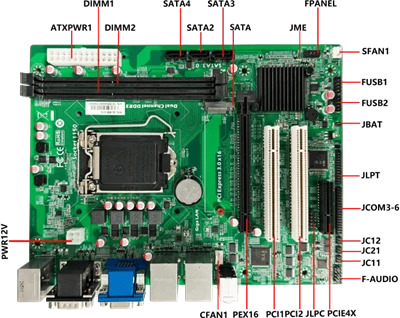
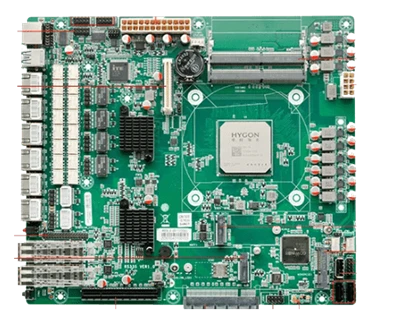
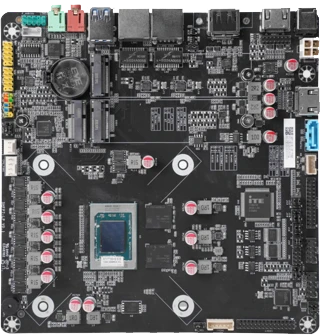
Components: Industrial motherboard components are generally different from commercial materials, and need to consider the requirements of industrial occasions such as high temperature resistance and moisture resistance.
PCB design: In order to strengthen the EMC/EMI performance of the motherboard and enhance the stability of the motherboard. Industrial motherboards are designed with 6-layer and above PCB circuit boards.
Platform options: Industrial motherboards generally use low-power chipsets to save energy and improve environmental adaptability.
The common platforms range from Intel Core [2], Nehalem to Sandybridge/Ivybridge, which was promoted in 2012, and ATOM Atom platform, AMD's LX series (LX800) to Fusion, etc.
Interface design: Due to the special use occasions of industrial motherboards, the design interface will be customized according to the use occasion or a large number of standard interfaces will be stacked to adapt to various interfaces.
Common interfaces include serial ports, USB, LAN, LPT, etc. In order to adapt to the environment, they are generally designed with surge protection and static discharge.
Expansion interfaces include PC104 family, PCI-E family, PCI family, etc., with industrial motherboards, the use of the backplane supports multiple expansions.
At the same time with multiple display functions such as VGA, LVDS, HDMI, DVI interface, etc.
Life cycle: Industrial use is based on stability, so it is hoped that there will be a long and stable supply cycle to ensure the stability of the overall equipment or system.
Protection function: Through special design, the industrial motherboard can realize the automatic restart of the watchdog when encountering abnormal conditions such as crashes, so as to ensure the high stability of the system in harsh environments.