



What is the difference between Android and Linux?
Although Android and Linux have the same kernel (Android is developed based on the Linux kernel), their positioning, architecture, ecology and applicable scenarios are significantly different: Android is a finished operating system dedicated to mobile devices, specially optimized for consumer/commercial mobile hardware such as mobile phones, tablets, smart TVs and Android OPS modules. It not only has an underlying design adapted to touch interaction, mobile networks (4G/5G) and low power consumption, but also builds a layered architecture including a hardware abstraction layer (HAL) and an application framework layer. The ecology is mainly based on mobile applications in APK format (such as WeChat, TikTok, and commercial display apps), and adopts an application sandbox mechanism. Each application is independently assigned permissions, and users are required to actively authorize functions such as camera and location. Linux itself is a general-purpose operating system kernel.
Android doesn't include a complete user interface and requires a GNU toolchain, desktop environment (such as GNOME or KDE), or server components to form a distribution (such as Ubuntu, CentOS, or Debian). It's suitable for desktop office applications, cloud computing servers, industrial control equipment (such as machine tool controllers), and routers. Applications are mostly installed via DEB/RPM packages or compiled from source code. Interaction is primarily via the mouse and keyboard. Permission management relies on traditional Linux user groups (with strict root permissions). It prioritizes open source flexibility and multi-scenario customization over usability on mobile devices. Simply put, Android is a "mobile system that works out of the box," while Linux (and its distributions) are "general-purpose system frameworks that can be built on demand."
Specification
|
Processor |
CPU |
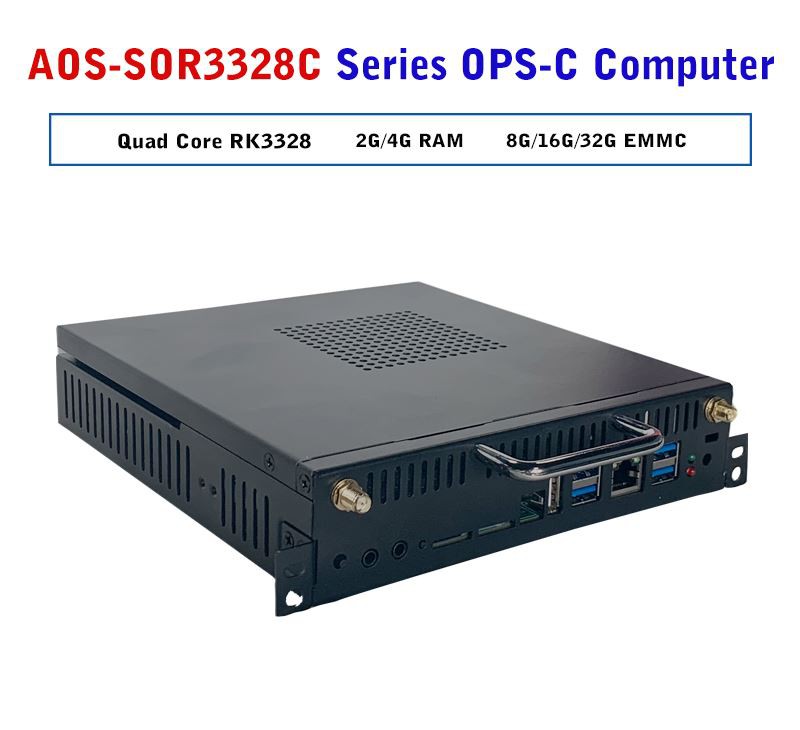
ARM ROCKCHIP RK3328 A53 Quad-Core 1.5GHz |
|
Chipset |
SOC |
|
|
Memory |
Capacity |
1GB SO-DIMM DDR4 2133 MHz memory , Max.4GB |
|
Storage |
EMMC TF Card SATA/MSATA |
8G, Max.64GB Supports 64G 128G-2TB SSD/HDD(optional) |
|
Display |
Graphics chip Output |
CPU integrated graphics HD Graphics HDMI single display 1 ×HDMI (Max. resolution:3840x2160) |
|
Ethernet |
Chip WIFI 3G/4G |
1 × RTL8211F-CG 10/100/1000M(RJ45 LAN) 1 x WIFI RTL8188EUS 2.4G/ AP6255 2.4G/5G Dual mode +BT(optional) Support 3G/4G(optional) |
|
I/O |
USB 3.0 Power button Reset OPS interface LED light IR DC JACK Audio Optical fiber |
4× USB3.0(Max. 4 groups)optional 1 × power button 1 × upgrade 1 × OPS interface(80pin) 1 x LED light 1 x IR(optional) 1 × DC JACK 1 × LINE-OUT & MIC-IN (optional),1× LINE IN(optional) Integrated 6-channel sound ALC662 sound card chip 1 x Fiber optic audio (optional) 1 ×COM (optional) |
|
Power |
Input Rated power |
DC 12~19V 30W |
|
Physical parameters |
Dimensions |
180mm (L) x 195mm (W)x42mm(H) |
|
Environment |
Temperature Humidity |
Working temperature:0°C ~50°C Storage temperature:-20~70°C 5%~90% No condensation |
|
Operating system |
Vision |
Android 7.1/ Linux |
In what aspects does Rockchip OPS have market competitive advantages?


What does Rockchip do?
Rockchip Electronics Co., Ltd. is a leading Chinese semiconductor design company specializing in the research and development of integrated circuits (ICs) and system-on-chips (SoCs). It not only offers core chips such as the RK3588 (8nm process, 6TOPS computing power, suitable for edge computing and industrial HMIs), the industrial-grade RK3568J (-40°C to 85°C wide operating temperature, suitable for power gateways), and the AI vision chip RV1126B (low power, suitable for industrial quality inspection), but also uses these chip solutions to power Rockchip's OPS products. For example, Rockchip OPS equipped with chips such as RK3328 and RK3568J, with low power consumption, wide operating temperature adaptability, and rich industrial interfaces (GPIO, RS232/485),It is suitable for industrial control scenarios such as device data collection and production line monitoring, and can also meet the stable operation requirements of commercial digital signage. Its technology focuses on low power consumption, AI computing power, and wide-temperature reliability. In addition to Rockchip OPS, its products are widely used in consumer electronics (Amazon Fire tablets, Xiaomi smart speakers), automotive electronics (partnering with BYD on in-vehicle systems), robotics, and other fields. With a market share exceeding 30% for industrial control chips and a global AIoT share projected to reach 8% by 2025, Rockchip's revenue in the first half of 2025 increased by 64% year-on-year, firmly placing it in the top tier of domestic AIoT chip manufacturers and establishing a differentiated competitive advantage over international vendors.
Ordering information
|
Sales Model |
Specification |
|
AOS-SOR3318H |
RK3328 1.5GHz 1G DDR4 Memory 8G EMMC |
|
AOS-SOR33216H |
RK3328 1.5GHz 2G DDR4 Memory 16G EMMC |
|
AOS-SOR33432H |
RK3328 1.5GHz 4G DDR4 Memory 32G EMMC |
Areas of application
Suitable for education, restaurants, hotels, shopping malls, company meetings, public affairs and other areas.
Hot Tags: Rockchip OPS, China, suppliers, manufacturers, factory, customized, wholesale, Super Mini Desktop Computer, Core Skylake Desktop Commercial Mini Computer, 2G Discrete Graph OPS Computer For Electronic Whiteboard, Transfer Panel Addtive OPS Computer, Rockchip Android Advertiser OPS Computer Module, DVD Player Intelligence Whiteboard OPS-C Computer


