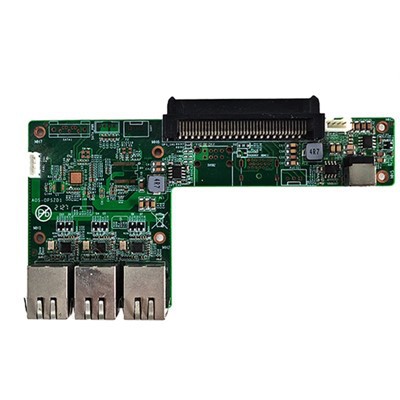
Hey there! As a supplier of the RK3368 Interactive Display Mainboard, I often get asked if this little powerhouse can be used for virtual reality (VR) applications. Well, let's dive right in and explore this question together.
First off, let's talk a bit about the RK3368 Interactive Display Mainboard. It's a pretty nifty piece of tech. It's got a quad - core Cortex - A53 CPU running at a decent clock speed, which gives it a good amount of processing power for a variety of tasks. The GPU is a PowerVR G6100, which is capable of handling some graphics - intensive work. And it comes with support for high - resolution displays, up to 4K in some cases.
Now, when it comes to VR, there are a few key factors we need to consider. One of the most important things is the processing power. VR applications are extremely demanding on the CPU and GPU. They need to render complex 3D environments in real - time and track the user's head movements accurately.
The RK3368's quad - core Cortex - A53 CPU can handle basic tasks, but for high - end VR experiences, it might struggle a bit. High - end VR games and simulations require a lot of processing muscle to keep everything running smoothly. However, for more lightweight VR applications, like simple 360 - degree video playback or basic VR educational experiences, the RK3368 could potentially do the job.
Another crucial aspect is the graphics performance. The PowerVR G6100 GPU in the RK3368 can produce decent graphics, but it's not in the same league as the high - end GPUs found in dedicated VR systems. VR graphics need to be sharp, detailed, and have a high frame rate to avoid motion sickness. The G6100 might be able to achieve a reasonable frame rate for less complex VR scenarios, but it won't be able to handle the latest and greatest VR games with all the bells and whistles.
Latency is also a big deal in VR. Latency refers to the delay between the user's head movement and the corresponding change in the VR environment. If the latency is too high, it can make the VR experience feel jerky and unpleasant. The RK3368's hardware and software need to work together to minimize latency. While it has the potential to keep latency at an acceptable level for some applications, it might not be as low as what you'd get with a more powerful and optimized VR system.
Now, let's talk about some of the advantages of using the RK3368 for VR. One of the biggest pluses is its cost. Compared to dedicated VR systems, the RK3368 Interactive Display Mainboard is relatively inexpensive. This makes it a great option for small businesses, educational institutions, or hobbyists who want to dip their toes into the world of VR without breaking the bank.
It's also quite versatile. You can use it in a variety of setups, whether it's a standalone VR station or integrated into a larger interactive display system. And since it supports high - resolution displays, you can get a relatively immersive VR experience on a big screen.
If you're looking for some related products that might work well with the RK3368 for VR setups, check out the OPS Adapter Connector Small Board. It can help with the connection and integration of different components in your VR system. Also, the Celeron J5005 J4105 J4005 OPS Computer and the H310 8Th 9Th Generation CORE OPS Computer are other options that could be used in more advanced VR setups.
In conclusion, while the RK3368 Interactive Display Mainboard isn't going to replace high - end VR systems for hardcore gamers or professional VR developers, it definitely has its place in the VR market. It's a cost - effective solution for those who want to explore VR on a budget or for less demanding applications.
If you're interested in using the RK3368 for your VR project or have any questions about it, don't hesitate to reach out. We're here to help you make the most of this technology and find the best solutions for your needs. Whether you're a small business looking to create a unique VR experience for your customers or an educator wanting to bring VR into the classroom, we can work with you to make it happen.
References


- General knowledge about RK3368 hardware specifications
- Industry knowledge of VR technology requirements