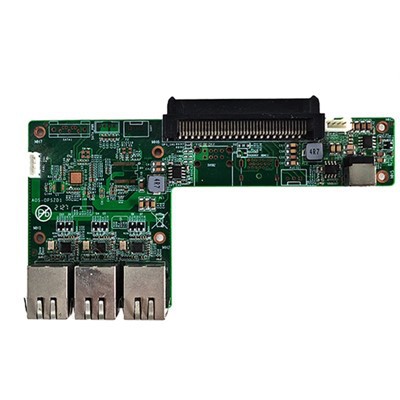
As a supplier of Transfer Panel Additive OPS (Open Pluggable Specification) Computers, I've often been asked whether our products can be used for big data analytics. In this blog post, I'll delve into the technical aspects, capabilities, and limitations of our Transfer Panel Additive OPS Computers in the context of big data analytics.
Understanding Big Data Analytics
Big data analytics involves examining large and diverse data sets to uncover hidden patterns, correlations, and other insights. These data sets, often referred to as the three Vs - volume, velocity, and variety - present unique challenges and requirements for the computing infrastructure. Volume refers to the massive amount of data generated daily, from social media posts and sensor readings to business transactions. Velocity is the speed at which data is generated and needs to be processed, such as real - time data streams from IoT devices. Variety encompasses different types of data, including structured (e.g., databases), semi - structured (e.g., XML files), and unstructured (e.g., text documents and images).
Technical Features of Transfer Panel Additive OPS Computers
Our Transfer Panel Additive OPS Computers are designed with several features that could potentially make them suitable for big data analytics tasks.
Processing Power
Many of our OPS Computers are equipped with high - performance processors. For example, some models come with RK3399A Touch Panel Android Motherboard, which features a powerful ARM - based processor. This processor offers multiple cores, allowing for parallel processing. Parallel processing is crucial for big data analytics as it enables the system to handle multiple data streams simultaneously, reducing the overall processing time.


Other models are powered by Intel 4 - 5 Generation CPU 3.5 - inch Industrial Motherboard. Intel CPUs are well - known for their high clock speeds and multi - threading capabilities. Multi - threading allows a single processor core to handle multiple threads of execution concurrently, further enhancing the processing efficiency.
Memory and Storage
Big data analytics requires significant amounts of memory to store and manipulate data during processing. Our Transfer Panel Additive OPS Computers are available with various memory configurations, ranging from a few gigabytes to tens of gigabytes. This ample memory capacity enables the system to hold large data sets in - memory, reducing the need for frequent disk I/O operations, which can be a bottleneck in data processing.
In terms of storage, our OPS Computers support different types of storage devices, including solid - state drives (SSDs). SSDs offer much faster read and write speeds compared to traditional hard disk drives (HDDs). This speed advantage is crucial for big data analytics, as it allows for quick access to large data files, improving the overall performance of data processing algorithms.
Connectivity
Our OPS Computers are equipped with a variety of connectivity options. They support high - speed network interfaces, such as Gigabit Ethernet and Wi - Fi, which are essential for transferring large amounts of data between different nodes in a big data analytics cluster. Additionally, they have USB ports and other interfaces that can be used to connect external storage devices or data acquisition modules, facilitating the integration of diverse data sources.
Use Cases in Big Data Analytics
There are several scenarios where our Transfer Panel Additive OPS Computers can be effectively used in big data analytics.
Small - Scale Big Data Projects
For small - scale businesses or research projects with limited big data analytics requirements, our OPS Computers can serve as a cost - effective solution. They can handle data sets that are not extremely large in volume and do not require real - time processing at a very high velocity. For example, a local retail store may use our OPS Computer to analyze customer purchase data to identify trends and preferences. The computer can process the transaction data stored in a local database, generate reports, and provide insights that can help the store optimize its inventory management and marketing strategies.
Edge Computing in Big Data
In the context of edge computing, our Transfer Panel Additive OPS Computers can play a crucial role in big data analytics. Edge computing involves processing data closer to the source of data generation, rather than sending all the data to a central data center. This approach reduces latency and bandwidth requirements. Our OPS Computers can be deployed at the edge, such as in IoT gateways or industrial sensors, to perform initial data processing and analysis. For instance, in a smart factory environment, our OPS Computer can be installed near a production line to analyze sensor data in real - time, detect anomalies, and trigger immediate actions to prevent equipment failures.
Limitations and Considerations
While our Transfer Panel Additive OPS Computers have many features that make them suitable for certain big data analytics tasks, there are also some limitations to be aware of.
Scalability
For large - scale big data analytics projects with extremely high data volumes and velocities, our OPS Computers may face scalability challenges. Big data analytics often requires a distributed computing environment, where multiple computing nodes work together to process data. Our OPS Computers are typically single - unit devices, and scaling up the processing power may be limited compared to large - scale server clusters. However, they can still be used as part of a hybrid solution, working in conjunction with other more powerful computing resources.
Complex Analytics Algorithms
Some big data analytics tasks involve complex algorithms, such as deep learning and machine learning algorithms. These algorithms require specialized hardware, such as graphics processing units (GPUs) or tensor processing units (TPUs), to achieve optimal performance. Most of our Transfer Panel Additive OPS Computers do not come with built - in GPUs or TPUs, which may limit their ability to handle these advanced analytics tasks efficiently.
Conclusion
In conclusion, our Transfer Panel Additive OPS Computers can be used for big data analytics, especially in small - scale projects and edge computing scenarios. Their processing power, memory, storage, and connectivity features make them capable of handling a wide range of data processing tasks. However, for large - scale and complex big data analytics projects, they may need to be integrated with other computing resources.
If you're interested in exploring how our Transfer Panel Additive OPS Computers can meet your big data analytics needs, we encourage you to reach out to us for a detailed discussion. We can provide more information about our product specifications, performance benchmarks, and help you determine the most suitable configuration for your specific requirements.
References
- Chen, M., Mao, S., & Liu, Y. (2014). Big data: A survey. Mobile Networks and Applications, 19(2), 171 - 209.
- Gantz, J., & Reinsel, D. (2012). The digital universe in 2020: Big data, bigger digital shadows, and biggest growth in the far East. IDC iView: IDC Analyze the Future, 2007(2012), 1 - 16.