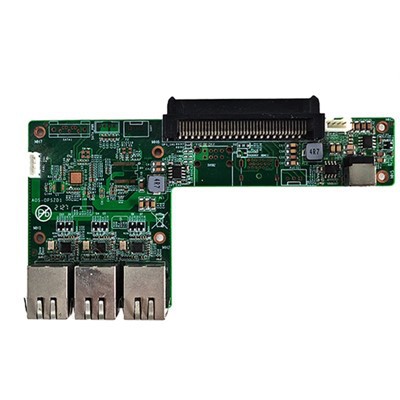
Hey there! As a supplier of RK3368 Interactive Display Mainboards, I often get asked about the data transfer speed of these bad boys. So, I thought I'd take some time to break it down for you in this blog post.
First things first, let's talk a bit about what the RK3368 is. It's a powerful processor that's commonly used in interactive display devices. These could be anything from digital whiteboards in classrooms to interactive kiosks in shopping malls. The mainboard built around the RK3368 is designed to handle a variety of tasks, and data transfer speed is a crucial factor in how well it performs.
So, what's the data transfer speed of the RK3368 Interactive Display Mainboard? Well, it's not a one - size - fits - all answer. There are several factors that can affect the data transfer speed, and I'll go through them one by one.
USB Ports and Data Transfer
One of the primary ways data gets in and out of the mainboard is through the USB ports. The RK3368 typically comes with USB 2.0 ports, and some models might also have USB 3.0 ports. USB 2.0 has a maximum theoretical data transfer speed of 480 Mbps (megabits per second). That's pretty decent for transferring smaller files like documents or low - resolution images. But if you're looking to transfer large video files or high - resolution graphics, it can be a bit slow.
On the other hand, USB 3.0 is a game - changer. It offers a maximum theoretical data transfer speed of 5 Gbps (gigabits per second), which is more than 10 times faster than USB 2.0. So, if your RK3368 mainboard has USB 3.0 ports, you can expect much quicker data transfers.
HDMI and Display Data Transfer
Another important aspect is the data transfer when it comes to the display. The RK3368 mainboard usually supports HDMI (High - Definition Multimedia Interface). HDMI is used to connect the mainboard to a display device, like a monitor or a TV.
The HDMI standard supported by the RK3368 can vary. Older HDMI versions might have lower data transfer speeds, but the more modern ones can handle a lot of data. For example, HDMI 2.0 can support data transfer speeds of up to 18 Gbps, which is more than enough to handle 4K video at high framerates. This is great for applications where you need to display high - quality graphics or videos, like in a digital signage setup.
Internal Storage and Data Transfer
The type of internal storage on the RK3368 mainboard also affects the data transfer speed. Some mainboards come with eMMC (embedded MultiMediaCard) storage. The data transfer speed of eMMC can vary depending on the version. Older eMMC versions might have speeds in the range of a few tens of megabytes per second, while newer ones can reach up to 400 MB/s or more.
If the mainboard has an option for an external SSD (Solid - State Drive) or HDD (Hard Disk Drive), the data transfer speeds can be different. SSDs generally offer much faster data transfer speeds compared to HDDs. An SSD can have read and write speeds in the range of hundreds of megabytes per second, while an HDD might be limited to around 100 - 200 MB/s.
Network Connectivity and Data Transfer
Network connectivity is another area where data transfer speed matters. The RK3368 mainboard usually supports Wi - Fi and Ethernet. The Wi - Fi standard can vary, but if it supports 802.11ac or 802.11ax (Wi - Fi 6), you can expect decent wireless data transfer speeds. 802.11ac can offer speeds up to 1.3 Gbps or more, and Wi - Fi 6 can go even higher.
Ethernet, on the other hand, provides a more stable and often faster connection. If the mainboard has a Gigabit Ethernet port, you can get a maximum data transfer speed of 1 Gbps. This is great for applications that require a lot of data to be transferred over the network, like streaming high - definition video or cloud - based services.
Comparing with Other Products
When it comes to data transfer speed, the RK3368 Interactive Display Mainboard holds its own, but it's also important to compare it with other products in the market. For example, the 7th generation CPU OPS might have different data transfer capabilities. The 7th generation CPUs are often more powerful and might have faster USB, PCIe, and other data transfer interfaces.
Similarly, the Ultra - thin Design OPS Adapter Small Board Stability Ops Small Board and the Ops Computer Transfer Small Board Brain Card have their own set of features and data transfer speeds. While the RK3368 is great for many applications, depending on your specific needs, you might find that one of these other products is a better fit.


Real - World Performance
In real - world scenarios, the data transfer speed might not always reach the theoretical maximums. There are factors like system overhead, the quality of the cables, and the performance of the connected devices that can affect the actual data transfer speed.
For example, if you're using a USB 3.0 cable that's of poor quality, it might not be able to support the full 5 Gbps speed. Similarly, if the connected device, like an external hard drive, has limited internal data transfer capabilities, it can bottleneck the overall transfer speed.
Applications and Data Transfer Requirements
The data transfer speed requirements can vary depending on the application. For a simple digital signage application that just displays static images or low - resolution videos, the data transfer speed requirements are relatively low. The mainboard can easily handle the data transfer through its USB or HDMI ports.
However, for more complex applications like a multi - user interactive whiteboard where multiple users are collaborating in real - time, the data transfer speed needs to be much higher. In such a scenario, having fast USB ports, high - speed network connectivity, and a fast internal storage system are essential.
Conclusion
To sum it up, the data transfer speed of the RK3368 Interactive Display Mainboard depends on several factors, including the type of USB ports, HDMI standard, internal storage, and network connectivity. While it offers decent data transfer speeds for a wide range of applications, it's important to understand your specific needs and consider how these factors can affect the overall performance.
If you're in the market for an RK3368 Interactive Display Mainboard or want to learn more about our products and how they can meet your data transfer requirements, don't hesitate to reach out for a purchase negotiation. We're here to help you find the best solution for your needs.
References
- General knowledge about RK3368 processors and data transfer technologies.
- Information from hardware manufacturers and industry reports on data transfer standards.